
Intel is going through a critical period. Facing stiff competition from AMD and ARM-based players, the American giant is struggling to regain its leadership position in the PC and server markets. In response to this pressure, Intel is counting on its brand-new generation of processors, the Intel Core Ultra Series 3, to reclaim lost market share and assert its innovation capabilities in a sector reshaped by artificial intelligence and modern computing demands.
At CES 2026 in Las Vegas, Intel officially unveiled its new Panther Lake mobile processors, known as the Intel Core Ultra Series 3. These chips represent a major technological milestone, manufactured using Intel 18A process technology, equivalent to a 2 nm process. Intel emphasizes that these processors are made in the USA, highlighting the importance of industrial sovereignty and local production in a highly competitive environment dominated by AMD and ARM.
A Diverse Range for All Use Cases
The Intel Core Ultra Series 3 stands out for its broad lineup, catering to different market segments. The “non-Ultra” models are designed for entry-level PCs and certain industrial applications, while the Ultra X9 and X7 models deliver impressive graphics performance, comparable to high-end gaming machines. These processors feature a 12-core Intel Arc B390 iGPU, up to 16 CPU cores, and an NPU delivering up to 50 TOPS, more than enough for AI-based applications.
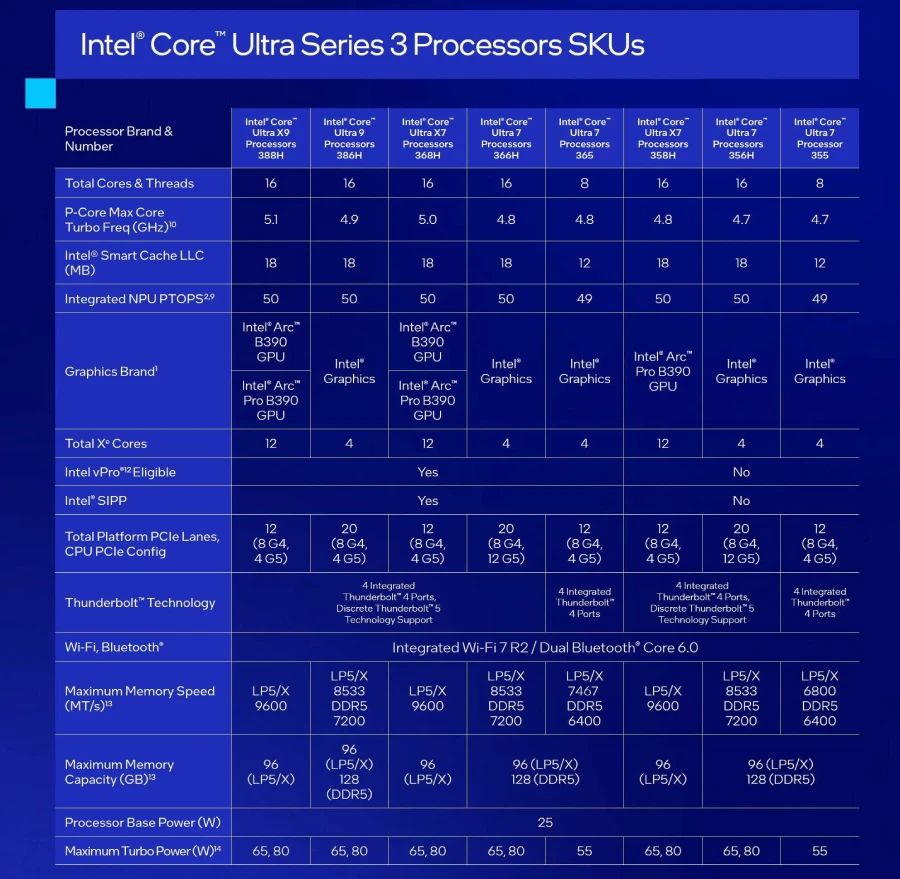
This diversity allows Intel to address varied needs while maintaining a competitive edge over AMD, which has strengthened its position in gaming PCs and servers, and ARM processors, which are increasingly present in mobile PCs and hybrid devices. By offering multiple models, Intel makes it easier for OEMs and distributors to create a wide range of devices at different price points.
Performance and Battery Life: Rising to the Challenge
According to Intel, the Core Ultra Series 3 delivers significant gains over the previous generation: up to 60% more multithreaded performance, 77% improved graphics performance, and up to 27 hours of video streaming on a Lenovo reference design. While these figures are theoretical, they demonstrate Intel’s focus on competing with ARM processors and AMD, while emphasizing energy efficiency and iGPU performance.
The Intel 18A process optimizes performance while improving energy consumption—a crucial advantage against ARM processors, known for their low power draw and long battery life. Intel has also integrated support for the latest connectivity standards, including Wi-Fi 7, Bluetooth 6.0, and up to 4 Thunderbolt 4 ports, ensuring a comprehensive user experience on PCs equipped with the Core Ultra Series 3.
A Strategic Launch Under the Spotlight
The launch of the Intel Core Ultra Series 3 comes at a delicate strategic moment. The 18A process has long symbolized internal delays and tensions, especially before CEO Pat Gelsinger’s departure in late 2024. Today, Intel appears to have regained positive momentum, supported by significant funding from Washington and Nvidia taking a 4% stake in the company.
Pre-orders began on January 6, 2026, with global availability set for January 27, 2026. Edge Computing versions will be available in Q2, accompanying early devices from OEMs such as Lenovo, HP, Dell, and Asus. This strategy aims to consolidate Intel’s position against AMD and anticipate the growing influence of ARM processors in PCs and hybrid machines.
Conclusion: Intel vs AMD and ARM
The Intel Core Ultra Series 3, built on the Intel 18A process and unveiled at CES 2026, marks a significant step for Intel. With improved performance, longer battery life, and AI compatibility, Intel is seeking to regain ground in the PC market against AMD and ARM processors. The success of this generation will determine whether Intel can reclaim its dominant position and continue showcasing its technological expertise in an increasingly competitive landscape.