
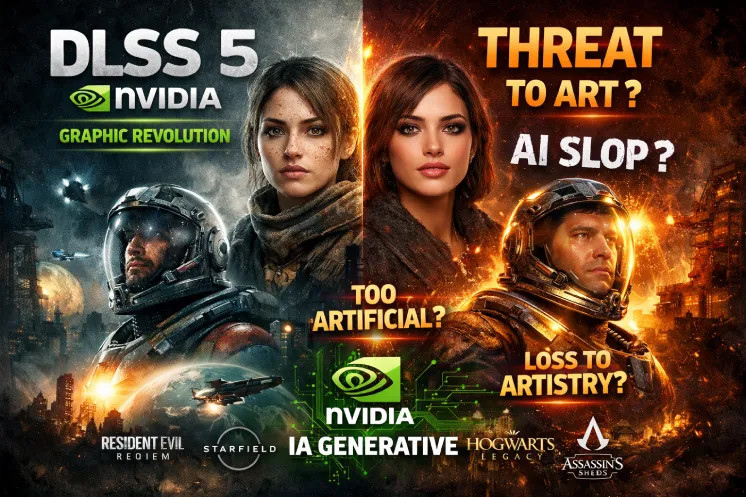
At the GTC conference, Nvidia unveiled DLSS 5, a technology marking a major turning point in the gaming world. Based on generative artificial intelligence, this innovation no longer just improves graphical performance—it directly transforms the visual rendering of games.
According to Jensen Huang, this is a true “GPT moment for graphics”, combining traditional rendering with AI to achieve an unprecedented level of realism.
DLSS 5 Nvidia: How Does This Generative AI Technology Work?
Unlike previous DLSS versions, which simply enhanced resolution using machine learning, DLSS 5 uses generative AI capable of modifying the image itself.
This technology analyzes a scene in depth:
-
Characters
-
Hair
-
Fabrics
-
Skin
-
Lighting
It then reconstructs these elements in real time to deliver a more realistic rendering, particularly in 4K. The goal is to simulate complex interactions, such as light on skin or reflections on materials.
DLSS 5 in Video Games: Realism Boost or Artificial Effect?
Nvidia demonstrated DLSS 5 on several popular games, including Starfield, Hogwarts Legacy, Resident Evil Requiem, and EA Sports FC.
The results show:
-
Clear improvements in lighting
-
More detailed textures
-
A more immersive overall experience
However, some players notice a strange effect. Images can appear overly smooth or artificial, as if excessively retouched by AI.
DLSS 5 and Generative AI: Controversy Around the “AI Slop” Effect
A major criticism concerns what some call “AI slop”, a rendering perceived as unnatural when generated by AI.
In certain cases:
-
Character faces change
-
Expressions become less authentic
-
Lighting effects appear unrealistic
For example, in Resident Evil, the main character looks modified, as if an Instagram filter was applied. In Starfield, the lighting can create a “studio” effect that doesn’t match the environment.
DLSS 5 Nvidia: Developer Control and Respect for Artistic Direction
To address criticism, Nvidia emphasizes that DLSS 5 provides advanced tools for developers.
They can adjust:
-
Effect intensity
-
Contrast and saturation
-
Color rendering
Developers can also exclude specific areas or objects from enhancements. This ensures the original artistic direction is preserved and prevents AI from distorting the game’s style.
Expert Opinions on DLSS 5 Nvidia in Gaming
Industry reactions are mixed.
On one hand, Todd Howard from Bethesda Game Studios highlights that DLSS 5 makes games more lively and immersive.
On the other hand, developer Mike Bithell strongly criticizes the technology, arguing it can harm artistic direction and create an inconsistent visual experience.
DLSS 5 Nvidia: Release Date and Compatible Games
DLSS 5 is scheduled for release in Fall 2026. For now, only a few games are confirmed, including Assassin’s Creed Shadows and The Elder Scrolls VI: Oblivion remake.
More titles are expected as studios adopt the technology.
DLSS 5 Nvidia and the Future of Gaming: A Revolution to Watch
DLSS 5 represents a major evolution in the use of AI in video games. It opens the door to unprecedented realism, but also raises important questions about the role of AI in artistic creation.
In summary, this technology could redefine the future of gaming, but its adoption will depend on balancing technological innovation with respect for the creators’ vision.
For more details, read the original article: Read the full article on The Verge